As the Great Houses return to the Imperial capital, the ancient calendar of court, ceremony, fashion, and society begins anew.
By Lysandra Hale, Senior Society and Culture Correspondent · 17th Day of the Bull, 3032 A.S.

There is a particular moment each year when Valtherion seems to remember that it is not merely the capital of an Imperium, but its court.
The change does not arrive by proclamation. It reveals itself gradually. First come the household vessels, slipping into the crowded approaches of the capital beneath the liveries of distant systems. Then the old residences awaken. Windows, dark through much of the year, begin glowing again along the Zhaolian Square, the Promenade of Xhaeryn, and the broad ceremonial avenues surrounding the Imperial precincts. Gardens are reopened, fountains restarted, ancestral standards raised from balconies, and entire household staffs return from provincial estates scattered across the stars.
By the second week of the Bull, the signs are unmistakable. The florists of Cyrillion Arcade begin refusing same-day commissions. Appointments at Maison Veyren, Atelier Sarielle, and House Corenne, among the capital’s most sought-after court dressmakers, disappear from their books. Jewelers along the Gouldaryn Crescent remain illuminated well after midnight. The terraces overlooking Lake Auriglas fill again with diners, musicians, and young nobles discovering that a table which sat empty in the Fish now requires the intervention of a secretary.
No formal announcement is required.
The Imperial Social Season has begun.
From the opening weeks of the Bull until the waning days of the Lion, Valtherion becomes the great gathering place of Imperial society. Archdukes leave the principal seats of their systems and return to the capital. Their heirs follow. Dukes, barons, clergy, officers, artists, financiers, scholars, performers, and those fortunate enough to possess the proper invitation soon fill a calendar in which a single evening may contain three dinners, two receptions, a concert, and a ball whose final guests will not emerge until the first light reaches the towers of the Imperial Crown District.
For some, the Season is indulgence.
For others, it is obligation.
For Valtherion, it is tradition.
The Return of the Great Houses
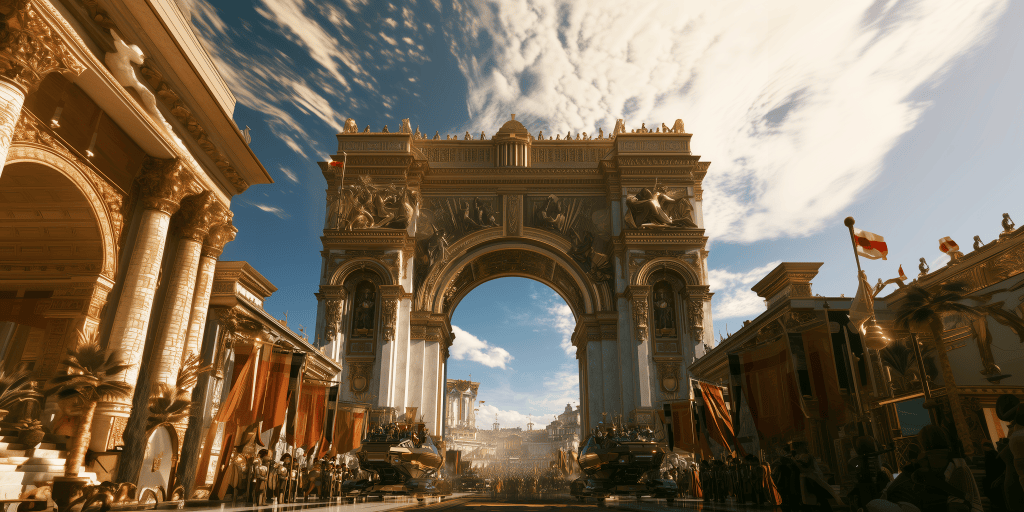
The principal arrivals began on the Eleventh Day of the Bull, when the first Archducal households entered the capital in ceremonial formation through the Arch of Selas Teryn, the traditional point of entry for Great House processions arriving from the Vaelorian Imperial Spaceport.
House Kyraethori came from Luthander beneath green and pale rose standards, its household vessels escorted by lacquered ceremonial escorts bearing the pink lotus of the House. By evening, the terraces of Shiun Court, the Kyraethori residence upon Valtherion, had been dressed in flowering lotus, suspended lanterns, and pale silk canopies in preparation for the House’s traditional Hana no Utage.
His Imperial Grace Archduke Kyōzumi Kyraethori arrived with Archduchess Élisanne and their children, Lord Kazuki, Lady Hanae, and Lord Naokatsu. Lady Hanae’s arrival gown, a layered composition of pale green silk threaded with flowering pink embroidery, has already inspired imitations in several ateliers, although none yet possess the original’s hand-worked Luthander thread.
House Montrevaux arrived from Caerulionis two days later, bringing musicians, vintners, household artisans, and what one exhausted steward at the Hotel Aurellian described as “enough formal wardrobe to clothe a provincial assembly.” Their Valtherion residence, Palais de Vaurelle, reopened with a private dinner for eighty-four guests beneath its famous blue-glass ceiling, followed the next evening by Lady Aveline Montrevaux’s Opening Musicale, the first important musical salon of the Season.
House Stratford of Téotl-Nahuican reopened Stratford House, its long terraces overlooking the imperial waterways, while House Andurénn of Seravelle returned to Casa Asterielle, where Archduke Azarel Andurénn traditionally hosts some of the Season’s smallest and most closely watched dinners.
House Aelthwyn of Yllarion arrived beneath silver and blue standards on the Fifteenth Day of the Bull. Its household is expected to host the Evening of a Thousand Lanterns at Yllarion Court Gardens early next month, an event remembered from last Season for floating lanterns released above the lake at midnight.
House Drauchvalen’s arrival from Noctis-Orien was, characteristically, more restrained. Its vessels entered the capital without the elaborate escort favored by several of its peers. The House took possession of Drauchvalen Hall, a dark stone residence overlooking the northern Courtward terraces, with little public ceremony.
This has not prevented considerable attention from following its younger members.
Then came House Olyenkov.
The Al-Zehari delegation announced itself with the severe magnificence expected of one of the Imperium’s most formidable Archducal families. Their procession from the Vaelorian Imperial Spaceport extended across nearly three kilometers of ceremonial road, accompanied by detachments of the Forgeward Guard in full dress armor and vehicles bearing the black, silver, and deep crimson heraldry of the House.
Archduke Mikhail Olyenkov and Archduchess Aelwenya were received at the Imperial Court that evening, while their children, Lord Dominik, Lord Vasily, Lady Milena, and Lord Pyotr, immediately became objects of the particular curiosity Valtherion reserves for young nobles of consequence.
House Valaeryn’s arrival carried a different significance.
Last Season, Kaelen Valaeryn entered Valtherion as Duke of Hinomori.
This year, the doors open before him as His Imperial Grace, Archduke Kaelen Valaeryn of Hikari-no-Ten.
Court protocol possesses its own quiet manner of recording history. Titles alter seating. They alter entrances. They determine which household is announced first, which procession moves before another, where a family stands during an Imperial reception, and whose name appears above whose upon an invitation.
A transformation that might occupy hundreds of pages of Imperial record becomes visible in society through something as simple as who enters the room first.
For House Valaeryn, the difference has been impossible to miss.
The Opening Court of the Bull
The Season will receive its formal beginning on the Twentieth Day of the Bull with the Opening Court of the Bull, an observance whose present form dates to the reign of Emperor Gahaegor II more than seven centuries ago.
The ceremony will take place within the Hall of the Five Radiances, one of the great state chambers of the Imperial Palace of Valtherion. Beneath a ceiling depicting the first five settled worlds Post-Severance, the Imperial Family will receive the Great Houses according to precedence.
The first presentation will begin precisely at the third afternoon bell.
The ceremony is among the most exactingly regulated of Valtherion’s traditions. Every approach, bow, introduction, garment, insignia, and order of entry is governed by customs so old that some have survived long after their original meanings faded from common memory.
Those sons and daughters entering full court society for the first time will also be formally presented. This year, among the most discussed are Lady Séverine Montrevaux, Lord Thaëlor Aelthwyn, Lady Rosamund Stratford, and Lord Naokatsu Kyraethori, each of whom will make their first full ceremonial appearance before the Imperial Family.
That evening, society will move from solemnity to celebration.
The Silverbough Ball, held at Qarethorne Palace, will open the first great sequence of formal entertainments. Nearly two thousand invitations have been issued, though fewer than seven hundred guests will be admitted to the principal dance floor at any one time.
Already, the capital is occupied with speculation over what will be worn.
House colors have become increasingly prominent in recent Seasons. Kyraethori pinks and greens are appearing in the windows of leading ateliers. The cold metallic shades favored by Noctis-Orien have been adopted by younger courtiers throughout the northern districts, while House Valaeryn is expected to make deliberate use of its own heraldic identity during what will inevitably be regarded as its first great entrance at Archducal rank.
Yet fashion at Valtherion is never merely fashion.
An inherited clasp may announce six centuries of lineage. A particular embroidery may identify the province in which one’s mother was born. An apparently decorative sash may denote military service, religious devotion, territorial office, or a marriage alliance older than the wearer.
“The great mistake is to imagine that court dress exists only to be beautiful,” observed Maelia Corven, Curator of Ceremonial Textiles at the Imperial Gallery of Living Arts. “Beauty is expected, certainly. But the finest dress at court is also biography. A person enters a room already telling you where they came from, whom they honor, what they inherit, and sometimes whom they intend to marry.”
On that last matter, this Season promises no shortage of interest.
An Heir, a Betrothal, and the Customs of Al-Zehar
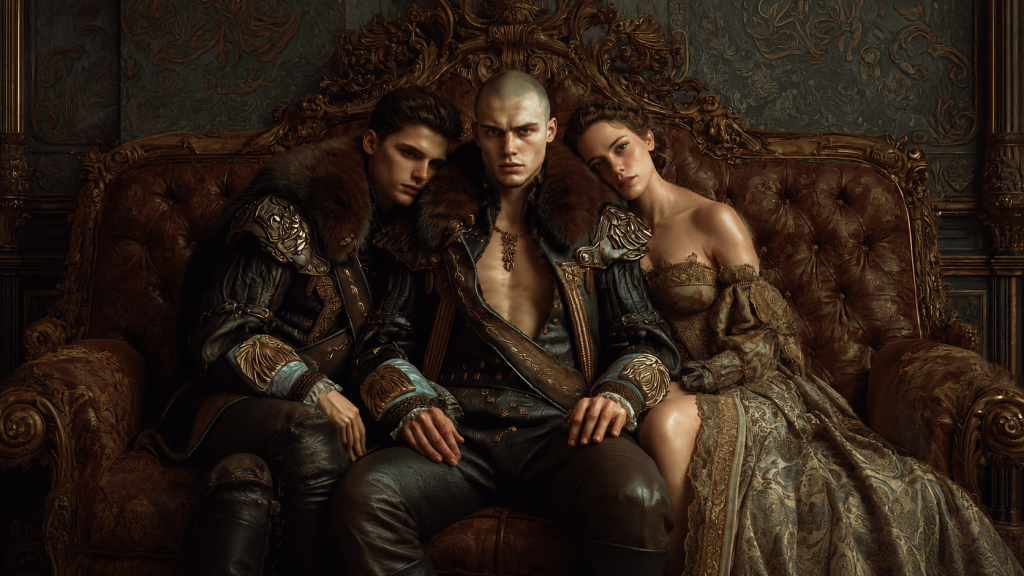
Few young nobles have attracted greater attention in the opening days than Lord Dominik Olyenkov, heir to the Archdukedom of the Al-Zehar System.
His position alone would guarantee scrutiny. His formal betrothal to Lady Seraphina of House Stratford guarantees considerably more.
Yet it is the customs Dominik has brought with him from Al-Zehar that have ensured his movements are followed from one drawing room to the next.
According to an old aristocratic practice still observed among several noble traditions of Al-Zehar, an heir of Dominik’s station may maintain an intimate household court composed of favored lesser lords and ladies. The custom predates several modern conventions of Imperial courtship and carries within Al-Zehar neither the secrecy nor the scandal sometimes attributed to it elsewhere.
Valtherion, which prides itself upon understanding every custom of the Imperium, has nevertheless discovered considerable reason to discuss this one.
Lord Dominik has scarcely entered a major reception without the company of a shifting circle of young nobles from Al-Zehari houses. Among those most frequently seen are Lord Samir Velnyr-Kosh, Lady Ivessa Mordrassian, Lord Cassel Varesh, and Lady Nehara Sayeed, each belonging to families long associated with the Olyenkov court.
They accompanied him to Lady Aveline Montrevaux’s musicale, occupied adjoining boxes at the Grand Opera of Valtherion, and were seen again during a late supper at the Crowned Peacock, where their table remained occupied until nearly the fifth morning bell.
Lady Seraphina, meanwhile, has displayed none of the distress certain hopeful observers appear to have anticipated.
At the Montrevaux musicale, she was seen conversing comfortably with Lady Ivessa for much of the evening before taking Lord Dominik’s arm for the procession into supper. Two nights later, Seraphina attended a private Al-Zehari dinner at House Olyenkov’s estate of Kostryev Dvor, where she reportedly remained until after midnight.
When a member of House Stratford was pressed upon the matter, she offered only a smile.
“Her Ladyship,” she replied, “was not betrothed without first learning something of the system into which she may one day marry.”
It was perhaps the least satisfying answer Valtherion could have received, and therefore the one most likely to ensure continued fascination.
Lord Leontis and Lord Caelor
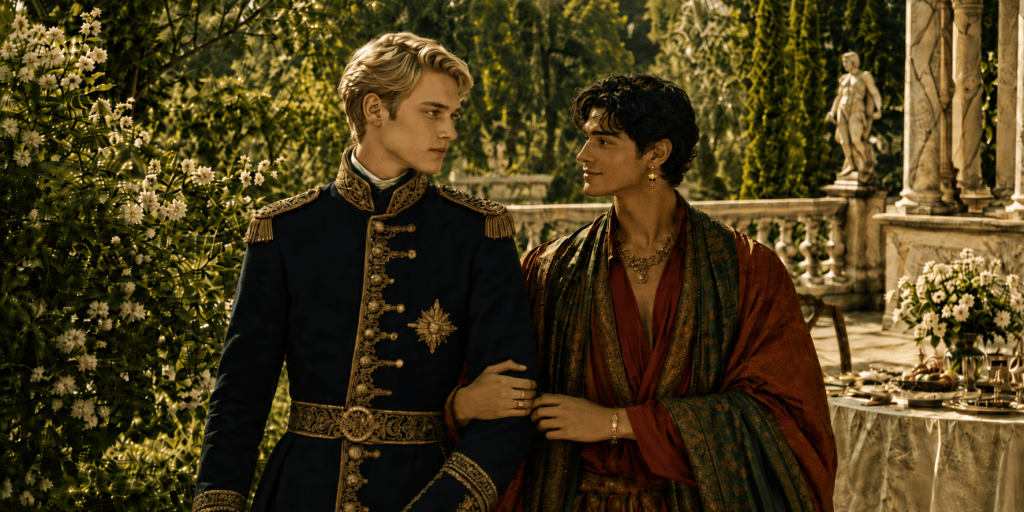
Elsewhere, attention has settled upon a quieter companionship.
Lord Leontis Drauchvalen, heir to the Archdukedom of Noctis-Orien, has been seen repeatedly in the company of Lord Caelor Andurénn, second son of His Imperial Grace Archduke Azarel Andurénn of Seravelle.
There has been no declaration.
There has been no formal announcement.
There has certainly been no confirmation from either House.
This has discouraged almost no one.
The two were first noted together during a private supper at Casa Asterielle on the Fourteenth Day of the Bull, when Lord Caelor was seated beside Leontis rather than among the younger members of his own household. They appeared again the following afternoon within the Upper Glass Galleries of the Imperial Conservatory, where witnesses observed them walking without attendants for nearly an hour.
Most recently, they attended a chamber performance of The Seven Rivers of Seravelle at the Palace of Amanzara, seated beside one another throughout the evening.
More interesting still are the activities of their fathers.
Their Imperial Graces, Archduke Azarel of House Andurénn and Archduke Alaric of House Drauchvalen have shared no fewer than three private dinners since arriving upon Valtherion. The latest occurred at the members-only Aëthýryn Club, where a reserved upper room was closed for nearly four hours.
The official explanation describes these meetings as discussions concerning “matters of common familial interest.”
Few phrases in Imperial society invite more speculation.
Whether affection has preceded negotiation or negotiation has encouraged affection remains, for the moment, something upon which both Houses have maintained admirable silence.
At a reception held by Duchess Vaelora Cendrys of Aramelle, one elderly Baroness was overheard remarking that the two young lords appeared “far too comfortable to be merely diplomatic.”
She declined to repeat the observation when approached afterward.
If a marriage is indeed being considered, its significance would reach far beyond the pleasures of the Season. Lord Leontis stands to inherit Noctis-Orien, while Lord Caelor belongs directly to the Archducal blood of Seravelle.
Maren Deyne may someday have occasion to write at great length about what such a union would mean for the balance of the Great Houses.
For now, society is content to notice that the two young lords have been smiling rather more frequently than diplomatic necessity would seem to require.
House Valaeryn Learns a New Place at Court
House Valaeryn presents another fascination entirely.
Its elevation to Hikari-no-Ten has transformed not only its political authority but its social position. Members of the family who last year occupied the highest ranks of ducal society now enter among the Archducal Houses themselves, with all the precedence, scrutiny, expectation, and sudden friendship that dignity entails.
The transformation became particularly visible during the Reception of Returning Houses at the Palace of Aethrûn, Golden Kasr of House Qasrani
Last year, House Valaeryn entered behind the older ducal delegations of House Morcant and House Tesseran.
This year, the Master of Ceremonies called the Valaeryn name before either.
Those unfamiliar with court society might find such a detail insignificant.
No one present did.
The younger Valaeryns have experienced the change more personally. Invitations have multiplied. Introductions once conducted politely now linger. Families with eligible sons and daughters have developed an extraordinary interest in Hikari-no-Ten’s literature, music, architecture, and social customs.
Several courtiers who last Season could scarcely remember the names of the Valaeryn children have, by remarkable coincidence, become devoted admirers of their accomplishments.
Valtherion has always possessed a remarkable capacity to discover affection shortly after a change in precedence.
Yet beneath the amusement lies something genuinely important.
The first Social Season of a newly elevated Great House functions almost as a second investiture. Political authority may be bestowed by Imperial decree, but society must learn the new arrangement through repetition. A House must be received, seated, introduced, courted, invited, and incorporated into the intricate personal relationships that connect the ruling families of the Imperium beyond law alone.
By the waning of the Lion, House Valaeryn will no longer feel newly Archducal.
That, perhaps, is one of the quieter purposes of the Season.
The House That Is Not Here
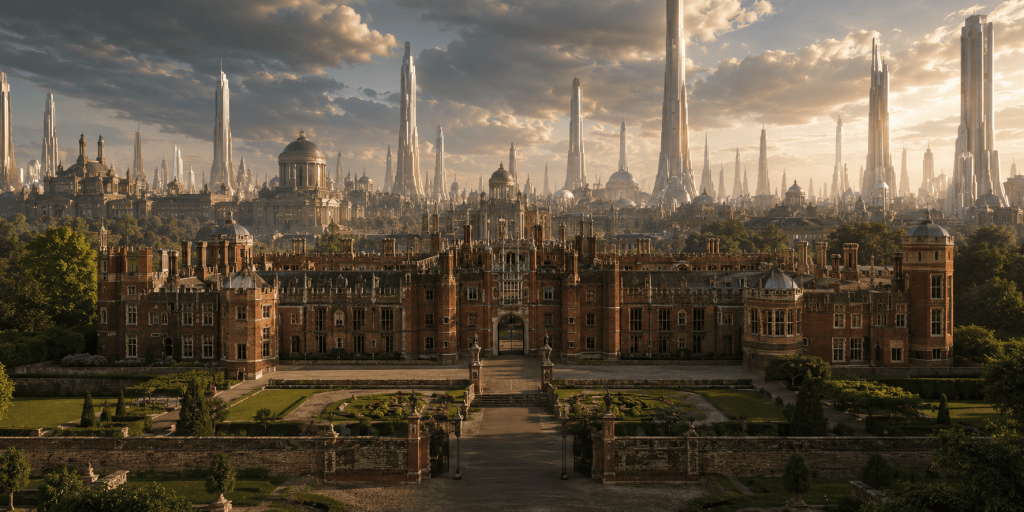
Not every Great House has returned.
Along the Viale di Loredano stands Khaen’syngtôn House, the Valtherion residence of the Archducal family of Tenojan. Ordinarily, it is among the brightest households of the summer months. Its white terraces overlook the Gardens of Avaroa, and in previous Seasons its upper salons remained illuminated until dawn.
Its annual Moonlight Reception has traditionally been one of the first major gatherings following the Opening Court.
This year, no invitations have been issued.
Her Imperial Grace Archduchess Elantra Windsorohai remains in the Tenojan System as the conflict with House Ratthi continues, and only a reduced household has been maintained upon Valtherion. The great entrance remains guarded, the gardens tended, and the House standard still flies above the roofline.
But most of the windows remain dark.
On an avenue increasingly alive with returning households, the stillness is difficult not to notice.
There is something sobering in it.
The Social Season is often spoken of as though the Imperium might, for several summer months, exist entirely within ballrooms, gardens, theaters, and candlelit dining chambers. House Windsorohai’s absence reminds Valtherion that the privileges of rank remain inseparable from its burdens.
There are years when duty demands a Great House stand beneath chandeliers before the Throne.
There are others when it requires them to remain among their fleets.
The Calendar Ahead
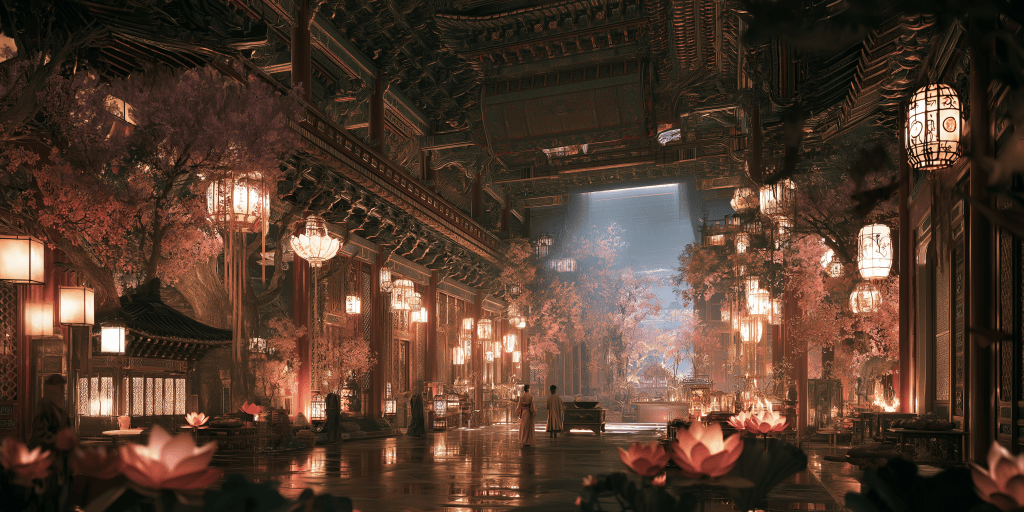
The Opening Court is only the beginning.
On the Twenty-Third Day of the Bull, House Montrevaux will host the Blue Masque of Caerulionis at Palais Montrevaux, where guests are traditionally required to arrive masked until the midnight procession.
The Twenty-Sixth will bring House Kyraethori’s Hana no Utage at Shiun Court, followed two days later by the Imperial Summer Regatta upon Lake Auriglas, where House-sponsored vessels compete before viewing terraces crowded with nobles and ordinary citizens alike.
The first week of the Twins will see the Sacrivanate Procession of the Three Graces, during which members of the Imperial Family and Great Houses attend rites honoring the Father, Mother, and Child at the Grand Sacrivanate Basilica of Auræthion.
Later will come the Aelthwyn Evening of a Thousand Lanterns, the Kassimba Rose Concert, the annual Olyenkov Winter Banquet, and the fiercely anticipated Valtherion Grand Stakes, where racing houses from across the Imperium compete before an audience known to regard the guest boxes with nearly as much interest as the course.
Then come the private events.
Engagement dinners.
Marriage negotiations.
Birth announcements.
Coming-of-age presentations.
Small suppers where no journalist is invited and half the decisions that shape the next generation of aristocratic life are quietly begun.
It is those evenings, as much as the great public balls, that give the Season its enduring importance.
The Capital Dresses for Summer
Beyond the courts of the Great Houses, the entire capital has begun its seasonal transformation.
The terraces overlooking the Canal of Seven Emperors are crowded again with evening diners. The promenades surrounding the Imperial Conservatory remain busy well past sunset. Musicians arriving from distant systems compete for engagements in private residences, while painters, jewelers, sculptors, florists, confectioners, vintners, perfumers, and dressmakers enter the most lucrative months of their year.
At Bellanor’s, a confectionery operating near the Courtward district for more than two centuries, its famous Archducal petits fours have already returned, each decorated in the heraldic colors of one of the Great Houses.
The pink lotus of Kyraethori sells first.
At Vell & Corren Jewelers, clients have begun requesting restored ancestral pieces rather than newly made ornaments, a preference its proprietor, Master Lucien Vell, attributes to what he calls “a season of inheritance.”
“Everyone wants something with a story this year,” he said. “A grandmother’s necklace. A father’s cuff. A stone worn at an old investiture. New jewels are beautiful, certainly, but an old jewel tells the room that you belonged before you arrived.”
Restaurants have revived menus served only during the Season. Hotels nearest the ceremonial avenues report near-total occupancy. Even smaller establishments participate, selling ribbons in Great House colors, miniature standards, inexpensive reproductions of court jewelry, and sweet pastries shaped into heraldic flowers and beasts.
Valtherion’s citizens watch the arrivals with an enthusiasm that has survived generations.
Children gather along procession routes to identify standards.
Older residents compare this year’s fashions with those of Seasons long past.
Public broadcasts devote evening segments to arrivals, charitable engagements, performances, and the inevitable question of which engagement will produce the most memorable moment of the summer.
There is pleasure in the spectacle, certainly.
But there is also familiarity.
For a civilization spread across systems separated by immense distances, the annual return of the Great Houses gives physical form to something that might otherwise remain abstract. Al-Zehar, Luthander, Seravelle, Noctis-Orien, Téotl-Nahuican, Yllarion, Caerulionis, Hikari-no-Ten, and the other great domains cease briefly to be distant names upon Imperial charts.
Their people arrive.
Their colors appear.
Their music is heard.
Their customs become subjects of conversation.
And Valtherion gathers them all.
More Than Splendor
It is easy to dismiss the Social Season as extravagance.
There will certainly be extravagance enough to satisfy anyone seeking it. Jewels will emerge from vaults in which they have rested since last summer. Ancient wines will be opened. Musicians will perform beneath ceilings painted before some present-day worlds were settled. Young nobles will dance beneath the watchful eyes of parents already contemplating marriages, and more than one supposedly accidental seating arrangement will have required weeks of discreet negotiation.
Yet to regard the Season as nothing more than spectacle is to misunderstand why it has endured.
The Imperium is vast. Its Great Houses govern beneath different suns, among peoples whose customs, climates, histories, and languages have diverged across centuries. An Archduke may spend most of the year surrounded by subjects who will never see Valtherion. His children may grow to adulthood upon a world hundreds of light-years from those of their eventual spouses, allies, or friends.
And still, each year, they return.
They bow within the same halls.
They observe the same precedence.
They hear the same ceremonial music.
They introduce another generation to families their ancestors have known for centuries.
Old friendships are renewed, new attachments formed, grievances softened over private tables, and traditions repeated because those who came before considered them worthy of repetition.
Somewhere within the coming months, Lord Dominik Olyenkov will dance with Lady Seraphina Stratford beneath the gaze of half the capital, perhaps with several members of his Al-Zehari court smiling nearby.
Lord Leontis Drauchvalen and Lord Caelor Andurénn may discover whether their increasingly public companionship is destined to become something more enduring.
House Valaeryn will learn to inhabit the grandeur and scrutiny of its new station.
House Windsorohai will remain absent, its empty place at court speaking quietly of duty performed elsewhere.
There will be scandals. There will be weddings. There will be rival gowns, unfortunate remarks, triumphant performances, reconciliations, romances, and dinners whose guest lists will be analyzed long after anyone remembers what was served.
And beneath all of it will remain the deeper purpose of the Season.
An Imperium may be governed by decree and defended by fleets, but civilization is sustained through relationships less easily recorded in law. It is carried in introductions remembered, vows renewed, customs observed, music repeated, friendships inherited, and the simple decision of one generation to return to the same halls where the generation before it once stood.
Valtherion is awake again.
The Houses have returned.
And another Imperial summer has begun.
Glory to the Imperium. Glory to Memory. Glory to Civilization Enduring.


Leave a Reply